BDB-Lab members involved




A long-read metagenomic catalog of near-finished bacterial genomes from Shanghai pet dogs captures gut microbial diversity across geographically distinct cohorts
A long-read metagenomic catalog of near-finished bacterial genomes from Shanghai pet dogs captures gut microbial diversity across geographically distinct cohorts
by Anna Cuscó, Yiqian Duan, Fernando Gil, Alexei Chklovski, M Nithya Kruthi, Shaojun Pan, Sofia Forslund, Susanne Lau, Ulrike Löber, Xing-Ming Zhao, Luis Pedro Coelho
in Genome Biology
Abstract
Background: Pet dogs are considered part of the family, and understanding their gut microbiomes can provide insights into both animal and household health. Most comprehensive studies, however, relied on short-read sequencing, resulting in fragmented metagenome-assembled genomes (MAGs) that miss mobile genetic elements, antimicrobial resistance genes, and ribosomal genes.
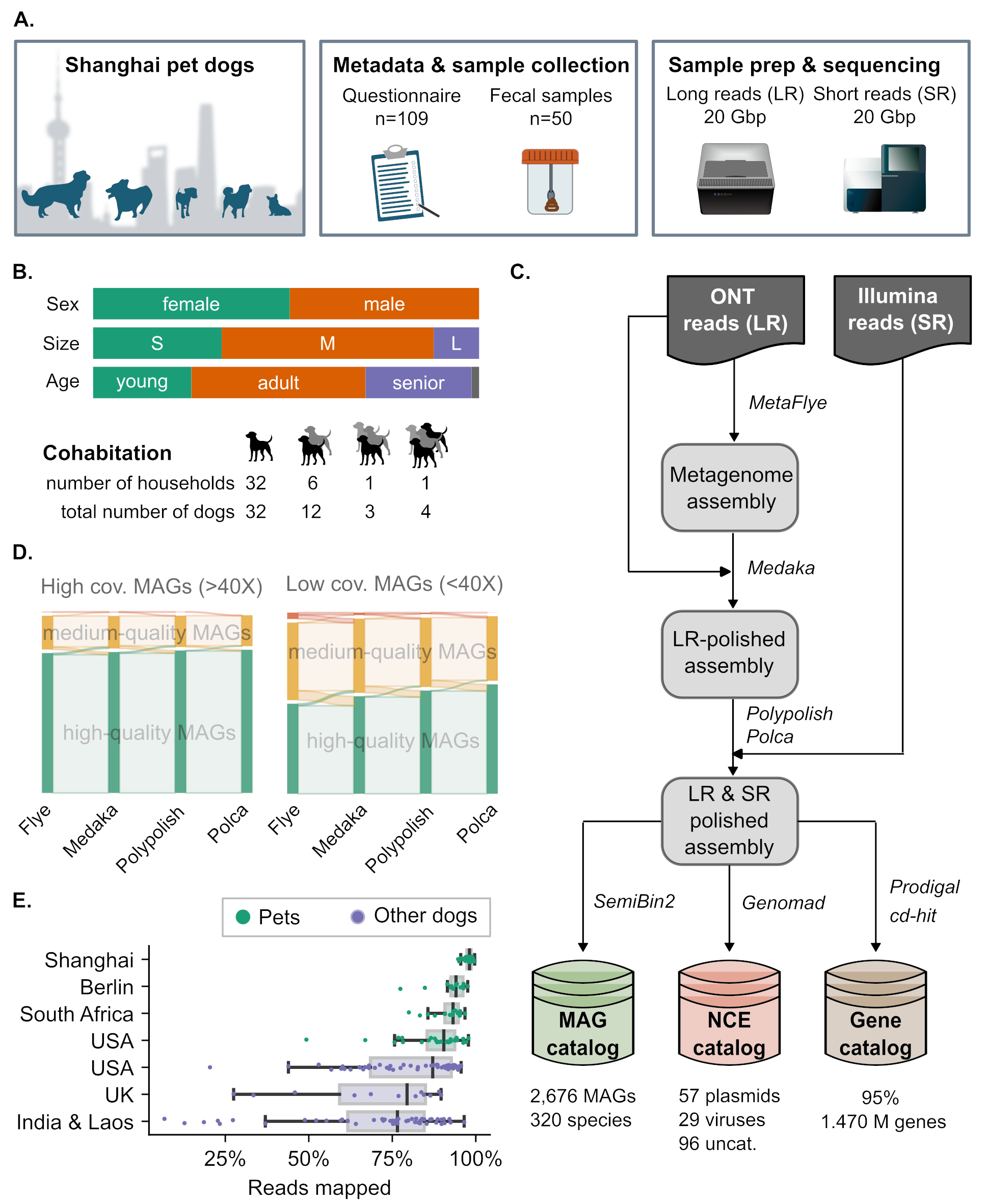
Results: We apply deep long-read metagenomics, polished with short reads, to fecal samples from 51 urban pet dogs in Shanghai, generating 2,676 MAGs representing 320 bacterial species. Approximately 72% of these MAGs achieve near-finished quality and often improve on the corresponding publicly available reference genomes. Comparisons with external datasets show that our Shanghai-based MAG catalog is representative of urban pet dogs worldwide, with a median read-mapping rate above 90%. Moreover, we retrieve 185 nonredundant clusters of circular extrachromosomal elements, including elements linked to antimicrobial resistance, which are also detected in external dog gut datasets. Finally, long-read metagenomics reveals a dynamic genome architecture, including a putative secondary chromosome in a Fusobacterium species.
Conclusions: We provide a high-quality reference resource and demonstrate the power of deep long-read metagenomics to resolve microbial diversity and genome architecture in complex host-associated microbiomes.
A companion website is available at: https://sh-dog-mags.big-data-biology.org/
Full text: https://doi.org/10.1186/s13059-026-04360-z
Copyright (c) 2018–2026. Luis Pedro Coelho and other group members. All rights reserved.